About
Episodes
Newsletter

Why every company now needs to think and operate like a lab team | Josh Woodward (Google Labs, Gemini, AI Studio)
Josh Woodward is the head of Google Labs, the Gemini app, and AI Studio. He has spent over 17 years at Google and oversees its longest-running and largest labs team, whose products include NotebookLM (now Gemini Notebook), Project Genie, and Flow. His job is to find, experiment with, and scale new AI products, and he has built one of the most distinctive product cultures in the industry for generating ideas, running experiments, and, even more importantly, knowing when to quit.In our in-depth conversation, we discuss:1. Why every company now needs to think and operate like a labs team2. Where the best ideas really come from3. The “almost possible” framework4. How to recognize genuine product-market fit early5. When to kill an idea6. What skills are rising in value in the AI era7. Why roles are not actually blurring into one universal builder role8. How to set up your internal labs team—Brought to you by:WorkOS—Make your app enterprise-ready, with SSO, SCIM, RBAC, and moreDX—Engineering intelligence for the AI era—Episode transcript: https://www.lennysnewsletter.com/p/why-every-company-now-needs-to-think—Archive of all Lenny's Podcast transcripts: https://www.dropbox.com/scl/fo/yxi4s2w998p1gvtpu4193/AMdNPR8AOw0lMklwtnC0TrQ?rlkey=j06x0nipoti519e0xgm23zsn9&st=ahz0fj11&dl=0—Highlights: https://lennyspodcast.com/mostreplayedmoments—Where to find Josh Woodward:• X: https://x.com/joshwoodward• LinkedIn: https://www.linkedin.com/in/joshwoodward—Where to find Lenny:• Newsletter: https://www.lennysnewsletter.com• X: https://twitter.com/lennysan• LinkedIn: https://www.linkedin.com/in/lennyrachitsky/—In this episode, we cover:(00:00) Introduction(02:53) Why every company now needs to think like a labs team(05:43) Where great ideas come from(07:43) The “almost possible” framework(11:52) Finding product-market fit(16:09) Falling in love with the problem, not the solution(17:57) When to kill an idea(19:35) Overseeing Google Labs and the Gemini app(22:21) Next consumer AI breakthroughs(24:32) Google’s vision for a personal assistant(27:18) What is overhyped and underhyped in AI right now(31:36) Skills rising in value: unlearning rate, explosive endurance, trust(35:45) Why roles are not blurring into one universal builder role(38:59) Explosive endurance rhythms(41:31) How planning has changed: rolling windows and 100-day milestones(43:37) Labs lifecycle stages(47:37) Tips for setting up an internal lab(54:00) The future of products in an AI world(56:26) Google Labs culture, rituals, and closing thoughts—References: https://www.lennysnewsletter.com/p/why-every-company-now-needs-to-think—Production and marketing by https://penname.co/. For inquiries about sponsoring the podcast, email podcast@lennyrachitsky.com.—Lenny may be an investor in the companies discussed. To hear more, visit www.lennysnewsletter.com
Latest Episodes
OpenAI’s Head of ChatGPT: We’re entering a new era of AI (again) | Tibo Sottiaux
Tibo Sottiaux leads ChatGPT and Codex at OpenAI. Under his stewardship, OpenAI has shipped some of its most consequential consumer launches: Codex, ChatGPT Work, and most recently, the new Dots personal agent platform. He joined me at DevDay, hours after his team launched more than 20 new products, to talk about where things are heading.We discuss:1. Dots, OpenAI’s new personal AI assistant2. Why most actions on the internet will soon be taken by agents3. Why loops, graphs, and fine-tuning agent workflows are a passing phase4. Which skills are trending up and down in the AI era5. How Tibo’s Dot warned him about a production outage five minutes before the launch6. OpenAI’s approach to AI safety—Brought to you by:WorkOS—Make your app enterprise-ready, with SSO, SCIM, RBAC, and moreDX—Engineering intelligence for the AI era—Episode transcript: https://www.lennysnewsletter.com/p/openais-head-of-chatgpt-were-entering—Archive of all Lenny's Podcast transcripts: https://www.dropbox.com/scl/fo/yxi4s2w998p1gvtpu4193/AMdNPR8AOw0lMklwtnC0TrQ?rlkey=j06x0nipoti519e0xgm23zsn9&st=ahz0fj11&dl=0—Where to find Tibo Sottiaux:• X: https://x.com/thsottiaux• LinkedIn: https://www.linkedin.com/in/thibault-sottiaux-27195366—Where to find Lenny:• Newsletter: https://www.lennysnewsletter.com• X: https://twitter.com/lennysan• LinkedIn: https://www.linkedin.com/in/lennyrachitsky/—In this episode, we cover:(00:00) Introduction to Tibo Sottiaux(01:12) How Tibo uses AI in his daily work(03:10) The vision for always-on AI agents(06:15) How AI will continue to change work(07:32) Bringing Codex, ChatGPT, and Dots together(08:20) The sci-fi inspiration behind the technology(09:02) Building AI with the community(10:13) Understanding the Dots structure(11:34) OpenAI’s open ecosystem and plugin revenue sharing(13:39) How plugins get discovered and recommended(14:39) The research behind Dots(16:20) Where humans will remain valuable(17:25) Agent fatigue, loneliness, and context switching(18:55) The pressure to do more with AI(20:09) An agent that spotted a production outage before a live demo(21:42) Agent guardrails and connecting multiple devices(23:25) The skills becoming more valuable in the AI era(25:56) Advice for people early in their careers(27:18) How teams build and ship inside OpenAI(28:59) Autonomy, trust, and learning from mistakes(30:45) Building for a future where agents dominate internet activity(32:41) What Tibo has changed his mind about(33:55) OpenAI’s approach to AI safety and alignment(36:15) Moving beyond model pickers toward simpler AI—Referenced:• OpenAI Dots: https://chatgpt.com/features/dots• Her on Netflix: https://www.netflix.com/title/70278933• Star Trek: https://www.imdb.com/title/tt0060028• Pi: https://pi.ai• OpenCode: https://opencode.ai• Notion: https://www.notion.com• Figma: https://www.figma.com• OpenClaw: https://openclaw.ai• Peter Steinberger on X: https://x.com/steipete• Grok Bot: https://x.ai/bot• Muse: https://muse.ai• Instinct: https://instinct.com• Ahmed Ibrahim on LinkedIn: linkedin.com/in/ahmedibrhm• The Hugging Face incident and the road ahead: https://openai.com/index/hugging-face-incident-and-the-road-ahead—Recommended book:• Neuromancer: https://www.amazon.com/Neuromancer-William-Gibson/dp/0441007465—Production and marketing by https://penname.co/. For inquiries about sponsoring the podcast, email podcast@lennyrachitsky.com.—Lenny may be an investor in the companies discussed. To hear more, visit www.lennysnewsletter.com

The grief, loneliness, and burnout sweeping through the tech industry right now | Molly Graham
Molly Graham is back for round two, and this one is even more powerful. Molly has spent more than 20 years helping organizations and the humans inside them navigate growth and change. She’s held leadership roles at Google, Facebook, Quip, and the Chan Zuckerberg Initiative and is the host of TED’s WorkLife podcast (which she took over from Adam Grant). She also runs Glue Club, a leadership community for senior operators, and writes a popular newsletter called Lessons.In our in-depth conversation, we discuss:1. Why Molly’s famous “give away your Legos” career advice no longer holds true in an AI world2. The grief, loneliness, and burnout sweeping through the tech industry right now3. Why delegating to AI is fundamentally different from delegating to a human4. The fear narrative around AI job displacement, and why it’s overblown5. Which Legos you should never give to AI6. What the best managers are doing right now—Brought to you by:WorkOS—Make your app enterprise-ready, with SSO, SCIM, RBAC, and moreDX—Engineering intelligence for the AI era—Episode transcript: https://www.lennysnewsletter.com/p/the-grief-loneliness-and-burnoutArchive of all Lenny's Podcast transcripts: https://www.dropbox.com/scl/fo/yxi4s2w998p1gvtpu4193/AMdNPR8AOw0lMklwtnC0TrQ?rlkey=j06x0nipoti519e0xgm23zsn9&st=ahz0fj11&dl=0Highlights: https://lennyspodcast.com/mostreplayedmoments—Where to find Molly Graham• X: https://x.com/molly_g• LinkedIn: https://www.linkedin.com/in/mograham• Substack: https://mollyg.substack.com• Website: https://glueclub.com—Where to find Lenny:• Newsletter: https://www.lennysnewsletter.com• X: https://twitter.com/lennysan• LinkedIn: https://www.linkedin.com/in/lennyrachitsky/—In this episode, we cover:(00:00) Molly Graham returns(03:34) What is “Give away your Legos”?(05:44) The origin story: Google, Facebook, and rapid scale(11:27) What still holds true in an AI world(18:13) Engineering’s identity shift: from rowing to steering(22:09) Loneliness and the collapse of team structure(24:06) The centaur and the reverse centaur(25:36) The fear narrative: AI-branded layoffs and overblown doom(29:20) Survey data: burnout is up to 55%, but half of people are thriving(35:07) Cleaning up AI slop(40:01) What’s actually different: delegating to AI vs. giving Legos to a human(42:02) Why every worker is now a manager, whether they want to be or not(49:07) Why giving things away creates space for new opportunities(55:27) Advice for people in the age of AI(59:38) What Legos you should never give away(01:03:12) The human sandwich: vision at the top, AI in the middle, humans at the end(01:05:00) Holding on to the things you love: grief, funerals, and what comes next(01:09:39) Slow takeoff: why you’re not too late(01:13:32) The most important skill to build right now(01:18:58) A message for managers and leaders(01:24:17) Key takeaways(01:31:42) Final thoughts—References: https://www.lennysnewsletter.com/p/the-grief-loneliness-and-burnout—Production and marketing by https://penname.co/. For inquiries about sponsoring the podcast, email podcast@lennyrachitsky.com.—Lenny may be an investor in the companies discussed. To hear more, visit www.lennysnewsletter.com
90 minutes of unfiltered product advice from Snap and Discord’s product chief | Peter Sellis
Peter Sellis was the first product manager at Snapchat, where he spent seven years building one of the most beloved consumer products in history. He went on to serve as Head of Product at Discord, where he helped drive some of the fastest user growth the platform had seen. Having left his role at Discord, he gets to be especially real and unfiltered — nothing to promote, no PR, no comms team.In our in-depth conversation, we discuss:1. Why Peter designs teams like . . . terrorist organizations2. What it was really like to manage Nikita Bier3. Why the median PM is so bad4. Why Snapchat’s ads business never reached its potential5. Why growth almost always comes from the core product6. Peter’s three “oxymorons” of great product management—Brought to you by:WorkOS—Make your app enterprise-ready, with SSO, SCIM, RBAC, and moreMercury—Radically different banking, now with Command—Episode transcript: https://www.lennysnewsletter.com/p/90-minutes-of-unfiltered-product—Archive of all Lenny's Podcast transcripts: https://www.dropbox.com/scl/fo/yxi4s2w998p1gvtpu4193/AMdNPR8AOw0lMklwtnC0TrQ?rlkey=j06x0nipoti519e0xgm23zsn9&st=ahz0fj11&dl=0—Where to find Peter Sellis:• X: https://x.com/petersellis• LinkedIn: https://www.linkedin.com/in/disgruntled• Website: https://pjs.lol—Where to find Lenny:• Newsletter: https://www.lennysnewsletter.com• X: https://twitter.com/lennysan• LinkedIn: https://www.linkedin.com/in/lennyrachitsky/—In this episode, we cover:(00:00) Introduction(02:48) Why Peter avoided podcasts until now(05:44) Designing teams like terrorist organizations(10:35) Cult versus terrorist org: the key distinction(11:19) Managing Nikita Bier(12:56) Building orgs that handle spiky talent(15:16) Why the median PM is probably bad(18:28) Is the PM profession getting better?(20:49) Snap’s three ads monetization challenges(25:03) Snap’s underrated product track record(27:57) Systems thinking(32:19) Instagram copying Snapchat’s worst features(33:32) Software moats(35:27) Taste, museum curators, and the art of saying no(40:05) OpenAI, ads, and the trust auction mechanism(46:25) Counterintuitive lesson: ride your best people hard(50:13) Why collaboration is often overrated(50:50) Growth lives in the core product(57:50) When to bet on something genuinely new(01:02:18) SpaceX and sunsetting the Falcon 9(01:07:01) Ambition as a learnable muscle(01:10:26) Long-term greedy: the ads philosophy(01:13:36) The Core Product Value framework(01:16:33) The three oxymorons of a great PM(01:20:29) Contrarian corner(01:26:00) Lightning round and final thoughts—References: https://www.lennysnewsletter.com/p/90-minutes-of-unfiltered-product—Production and marketing by https://penname.co/. For inquiries about sponsoring the podcast, email podcast@lennyrachitsky.com.—Lenny may be an investor in the companies discussed. To hear more, visit www.lennysnewsletter.com
How we built Grok Bot in a month | Roman Ugarte (SpaceXAI)
Roman Ugarte helped incubate and build Grok Bot, the popular new knowledge-work agent from SpaceXAI. A small, isolated team took it from first line of code to a working internal product in four weeks, and to a hugely successful public launch just three weeks later. Before Grok Bot, Roman led Growth at Cursor, where he helped scale the company from 15 people to over 1,000 before its acquisition by SpaceX.In our in-depth conversation, we discuss:1. The origin story of Grok Bot2. The key decision to build it from scratch instead of adding it to Cursor3. Why the team personally onboarded nearly 300 of its first users4. The two early product decisions that made Grok Bot so successful5. Their “colleague-pilled” product philosophy6. Roman’s advice on moats, and what has allowed Cursor to keep winning in the most competitive market in the world—Brought to you by:WorkOS—Make your app enterprise-ready, with SSO, SCIM, RBAC, and moreMercury—Radically different banking, now with Command—Episode transcript: https://www.lennysnewsletter.com/p/how-we-built-grok-bot-in-a-month—Archive of all Lenny's Podcast transcripts: https://www.dropbox.com/scl/fo/yxi4s2w998p1gvtpu4193/AMdNPR8AOw0lMklwtnC0TrQ?rlkey=j06x0nipoti519e0xgm23zsn9&st=ahz0fj11&dl=0—Where to find Roman Ugarte:• X: https://x.com/romanugarte_• LinkedIn: https://www.linkedin.com/in/romanugarte• Website: https://x.ai—Where to find Lenny:• Newsletter: https://www.lennysnewsletter.com• X: https://twitter.com/lennysan• LinkedIn: https://www.linkedin.com/in/lennyrachitsky/—In this episode, we cover:(00:00) Introduction(02:09) The origin story: building from scratch in one month(08:40) Why Grok Bot was built as a separate product(11:20) Manually onboarding a couple hundred people(14:29) Hiding internal mechanics from users(18:41) Timeline from beta to public launch(19:14) Unshipping features and simplifying(23:50) Early use cases and feedback(26:50) Product philosophy: “Grok Bot can now”(30:02) Cloud-first architecture(33:12) The fresh-start advantage(35:54) The vision: a true team of AI colleagues(39:20) The “colleague-pilled” framework(42:36) Work versus personal: one product or two?(47:14) Long-lived agents, persistent memory, and the computer abstraction(51:04) Grok Bot as an always-on infovore and chief of staff(53:35) How fast the team moves and what preserves the startup feeling(58:20) SpaceXAI pillars(1:00:44) The first 90% vs. the last 10%(1:03:30) Moving fast at scale(1:06:40) How Cursor kept winning in the most competitive market in the world(1:10:04) Company values: “deleting the product” and “just do the thing”(1:11:45) Moats: discovered, not planned(1:15:11) Tips for new users and power users(1:18:00) Lightning round and final thoughts—References: https://www.lennysnewsletter.com/p/how-we-built-grok-bot-in-a-month—Production and marketing by https://penname.co/. For inquiries about sponsoring the podcast, email podcast@lennyrachitsky.com.—Lenny may be an investor in the companies discussed. To hear more, visit www.lennysnewsletter.com
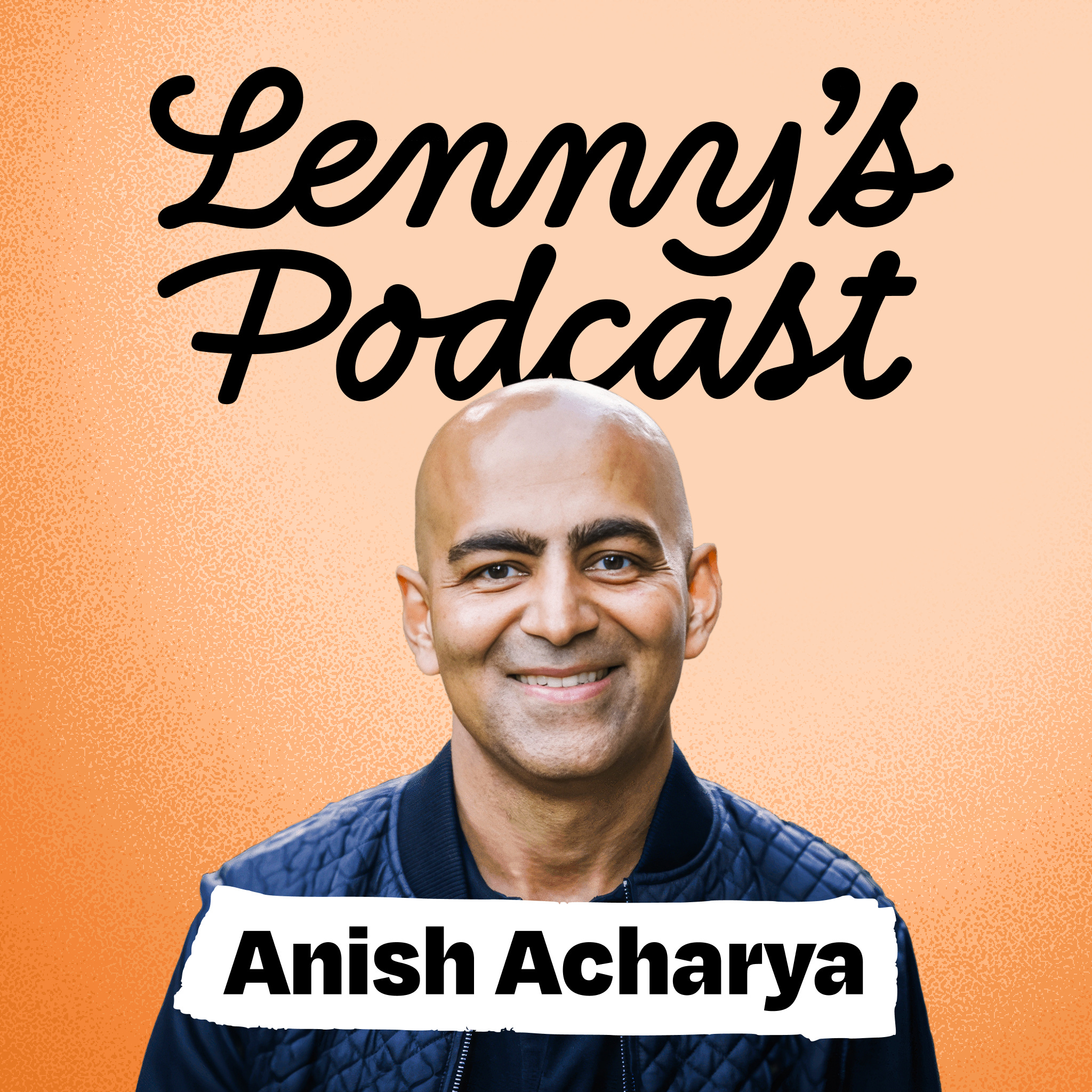
Why companies are becoming a series of loops | Anish Acharya (a16z)
Anish Acharya is a General Partner at Andreessen Horowitz (a16z), where he has focused on consumer investing. Anish is one of the most insightful, thought-provoking, and in-the-weeds product investors I’ve met, and this conversation will get your mind buzzing. Before joining a16z, Anish was a serial founder and operator: he founded SocialDeck, which he sold to Google, then led multiple efforts inside Google before founding Snowball, which he sold to Credit Karma. At Credit Karma he rose to VP of Product and then GM of the consumer product and the broader credit card business.In our in-depth conversation, we discuss:1. Why you don’t have to worry about becoming part of the “permanent underclass”2. Why company building will now involve creating a series of loops3. What’s happening in consumer right now4. Why the biggest opportunity in consumer is “/loop, make me happier”5. Why moats are discovered, not designed6. The rising importance of distribution as a moat7. Being a model sommelier—Brought to you by:WorkOS—Make your app enterprise-ready, with SSO, SCIM, RBAC, and moreMercury—Radically different banking, now with Command—Episode transcript: https://www.lennysnewsletter.com/p/why-companies-are-becoming-a-series—Archive of all Lenny's Podcast transcripts: https://www.dropbox.com/scl/fo/yxi4s2w998p1gvtpu4193/AMdNPR8AOw0lMklwtnC0TrQ?rlkey=j06x0nipoti519e0xgm23zsn9&st=ahz0fj11&dl=0—Where to find Anish Acharya:• Andreessen Horowitz: https://a16z.com/author/anish-acharya/• LinkedIn: https://www.linkedin.com/in/anishacharya/• X: https://x.com/illscience• SoundCloud: https://soundcloud.com/illscience—Where to find Lenny:• Newsletter: https://www.lennysnewsletter.com• X: https://twitter.com/lennysan• LinkedIn: https://www.linkedin.com/in/lennyrachitsky/—In this episode, we cover:(00:00) Introduction(02:25) The fear of AI creating a permanent underclass(05:25) Why AI takeoff may be slower than expected(08:02) How companies are actually adopting AI(11:25) Building AI products with loops(15:25) Why human intuition still matters(20:19) What the winners in AI are doing differently(21:41) Generalists vs. specialists(26:22) How to become a model sommelier(32:03) /loop make me happier(36:15) Why Anish is optimistic about the future of AI(42:47) What happens when models become too dangerous(46:29) How AI will change jobs and ambition(51:34) The state of consumer AI(54:30) How to build a durable moat in AI(59:25) The power of distribution and word of mouth(01:04:30) Making bigger bets and rethinking pricing(01:09:17) Advice for product builders in the AI era(01:11:48) Lightning round and final thoughts—References: https://www.lennysnewsletter.com/p/why-companies-are-becoming-a-series—Production and marketing by https://penname.co/. For inquiries about sponsoring the podcast, email podcast@lennyrachitsky.com.—Lenny may be an investor in the companies discussed. To hear more, visit www.lennysnewsletter.com